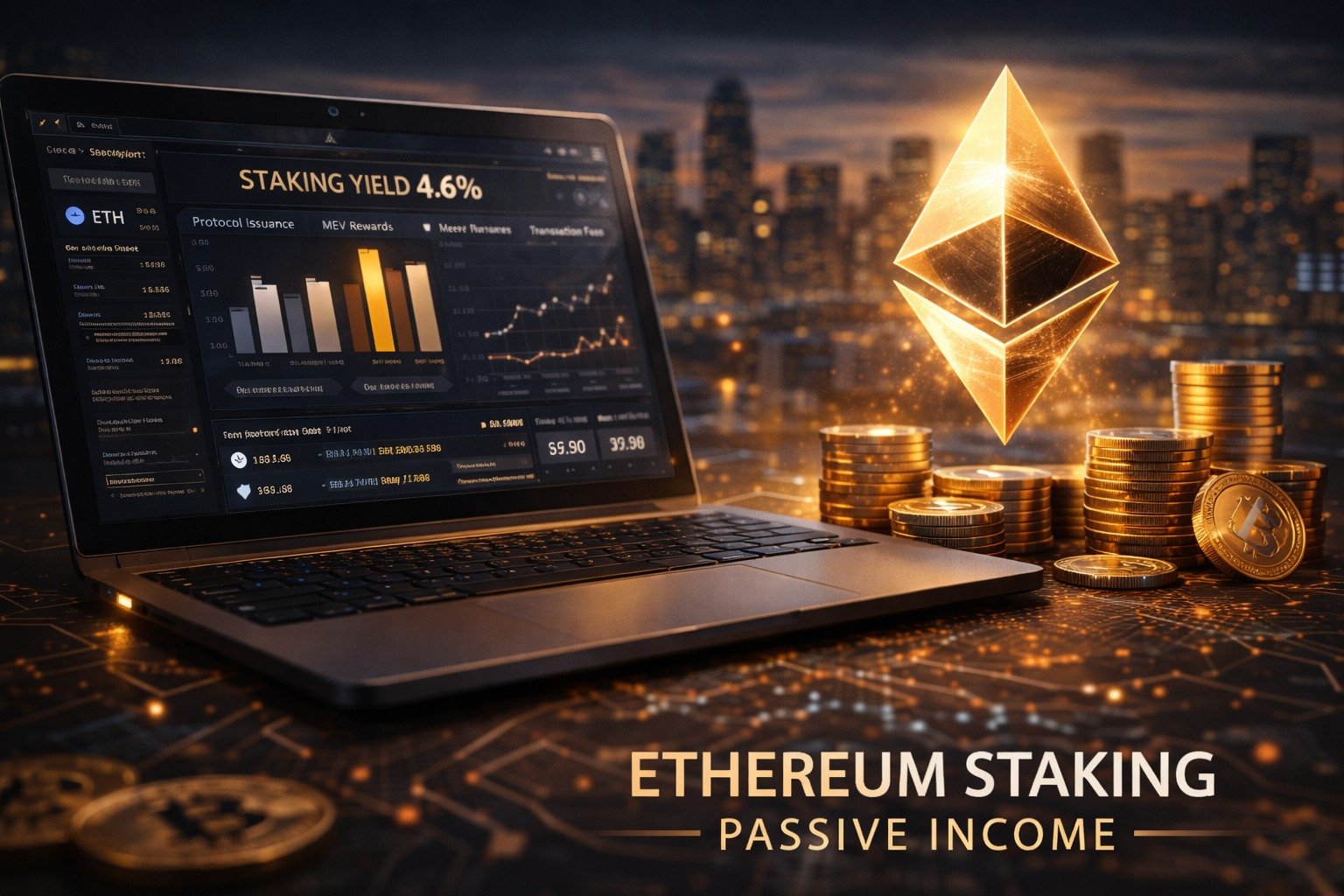
In 2026, the Ethereum network secures over $2.5 trillion in tokenized assets, from Real-World Assets (RWAs) to decentralized finance (DeFi) protocols. The engine that powers this security is Proof of Stake (PoS). By staking your ETH, you are effectively “renting” your capital to the network to validate transactions, receiving a portion of the network’s fees and newly minted ETH in return.
- The Yield Architecture: How Staking Works in 2026
Staking yield is comprised of three distinct revenue streams:
Protocol Issuance: New ETH created by the network (similar to a “dividend”).
Transaction Fees: A portion of the “gas” fees paid by users to move money on-chain.
MEV (Maximal Extractable Value): Extra profit generated by reordering transactions for efficiency.
In 2026, the average annual percentage rate (APR) for ETH staking sits between 3.5% and 5.2%. While this may seem lower than the “DeFi summer” of years past, it is considered the “Risk-Free Rate” of the crypto economy, backed by the security of the blockchain itself rather than a risky lending platform. - Choosing Your Staking Strategy: Four Tiers of Participation
Depending on your technical skill and capital (ETH) amount, there are four primary “rails” to enter the staking market in 2026.
Tier 1: Solo Staking (The Gold Standard)
Requirement: 32 ETH.
Hardware: A dedicated home server (like a DappNode or Avado).
Vibe: Maximum Sovereignty.
Benefit: You keep 100% of the rewards. You are the “Bank.” There is zero counterparty risk.
Tier 2: Liquid Staking Tokens (LSTs)
Requirement: No minimum (invest as little as 0.01 ETH).
Platforms: Lido (stETH), Rocket Pool (rETH), and Mantle (mETH).
Benefit: When you stake, you receive a “receipt token” (like stETH) that represents your deposit. This token increases in value or quantity and can be used in other DeFi protocols, effectively “double-dipping” your yield.
Tier 3: Restaking (The 2026 Alpha)
Requirement: An existing LST (like stETH).
Platform: EigenLayer.
Benefit: Restaking allows you to use your already-staked ETH to secure additional networks (Active Validated Services). This can boost your yield by an extra 2-4%, though it comes with higher “slashing” risk.
Tier 4: Exchange Staking (Custodial)
Requirement: No minimum.
Platforms: Coinbase, Kraken, or Binance.
Benefit: One-click simplicity. However, the exchange typically takes a 25% commission on your rewards. For the professional WealthArca reader, this is usually the least efficient path. - The “Long-Hedge” Strategy for 2026
Successful Ethereum investors in 2026 don’t just stake; they optimize.
Tax Efficiency: In many jurisdictions, receiving staking rewards is a taxable event. We recommend using Crypto tax software to track your cost basis daily.
Hardware Security: If you are using Liquid Staking, always store your LST tokens in a Cold wallet for crypto (like the Ledger Flex or Trezor Safe 7). Never leave your “receipt tokens” on an exchange.
Compounding: Set your rewards to “Auto-Compound” to benefit from the eighth wonder of the world. A 5% yield compounded over 10 years turns 100 ETH into roughly 162 ETH—regardless of price action. - Risks: Understanding “Slashing” and Liquidity
At WealthArca, we value candor. Staking is not “free money.”
Slashing: If your validator acts maliciously or stays offline for too long, the network can penalize you by taking a portion of your ETH.
Smart Contract Risk: If you use a Liquid Staking provider, you are trusting their code. Stick to audited, blue-chip protocols.
De-pegging: In times of extreme market stress, an LST (like stETH) might trade for slightly less than 1 ETH. Long-term holders shouldn’t panic, as the 1:1 redemption is guaranteed by the protocol once the stress subsides.
No responses yet