Introduction
Decentralized Finance (DeFi) has fundamentally changed how people borrow, lend, trade, and invest without relying on traditional financial institutions. Built on blockchain technology and powered by smart contracts, DeFi applications have created an open financial ecosystem where transactions occur transparently and automatically. Yet, despite this progress, most smart contracts remain static. They execute predefined rules but cannot adapt to changing market conditions or make informed decisions based on real-time data.
Artificial Intelligence (AI) is beginning to change that. By combining AI with blockchain technology, developers are creating a new generation of AI-driven smart contracts that are capable of analyzing data, adjusting strategies, identifying risks, and automating increasingly complex financial operations. These intelligent contracts have the potential to make decentralized finance more efficient, secure, and accessible.
Rather than replacing traditional smart contracts, AI enhances their capabilities by enabling adaptive decision-making while preserving blockchain’s transparency and trustless execution. As AI models become more sophisticated and blockchain infrastructure continues to evolve, AI-driven smart contracts could become one of the most significant technological advancements in Web3.
This article explores what AI-driven smart contracts are, how they work, their applications in DeFi, benefits, challenges, investment opportunities, and the future of intelligent blockchain automation.
What Are Smart Contracts?
Smart contracts are self-executing programs stored on a blockchain.
They automatically execute predefined actions when specific conditions are met.
For example:
- Transfer cryptocurrency
- Approve loans
- Execute token swaps
- Distribute staking rewards
- Mint NFTs
- Manage decentralized governance
Once deployed, smart contracts execute exactly as programmed without requiring intermediaries.
The Limitations of Traditional Smart Contracts
While revolutionary, traditional smart contracts have important limitations.
Static Logic
Rules cannot adapt after deployment without upgrades.
Limited Decision-Making
Contracts only execute predefined instructions.
No Context Awareness
Traditional contracts cannot interpret complex market conditions.
Heavy Dependence on Oracles
External data sources must feed information into blockchain applications.
Inflexible Automation
Complex financial strategies often require human oversight.
These limitations have motivated developers to integrate AI into blockchain systems.
What Are AI-Driven Smart Contracts?
AI-driven smart contracts combine blockchain technology with artificial intelligence to create contracts capable of intelligent decision support and adaptive automation.
Instead of merely following fixed instructions, AI systems can analyze external information and generate recommendations or parameters that smart contracts use within predefined boundaries.
Depending on the design, AI components may:
- Analyze financial markets
- Detect fraud
- Optimize investment strategies
- Evaluate lending risks
- Predict liquidity needs
- Recommend portfolio adjustments
- Improve yield farming strategies
The blockchain remains responsible for securely executing transactions, while AI provides data-driven intelligence.
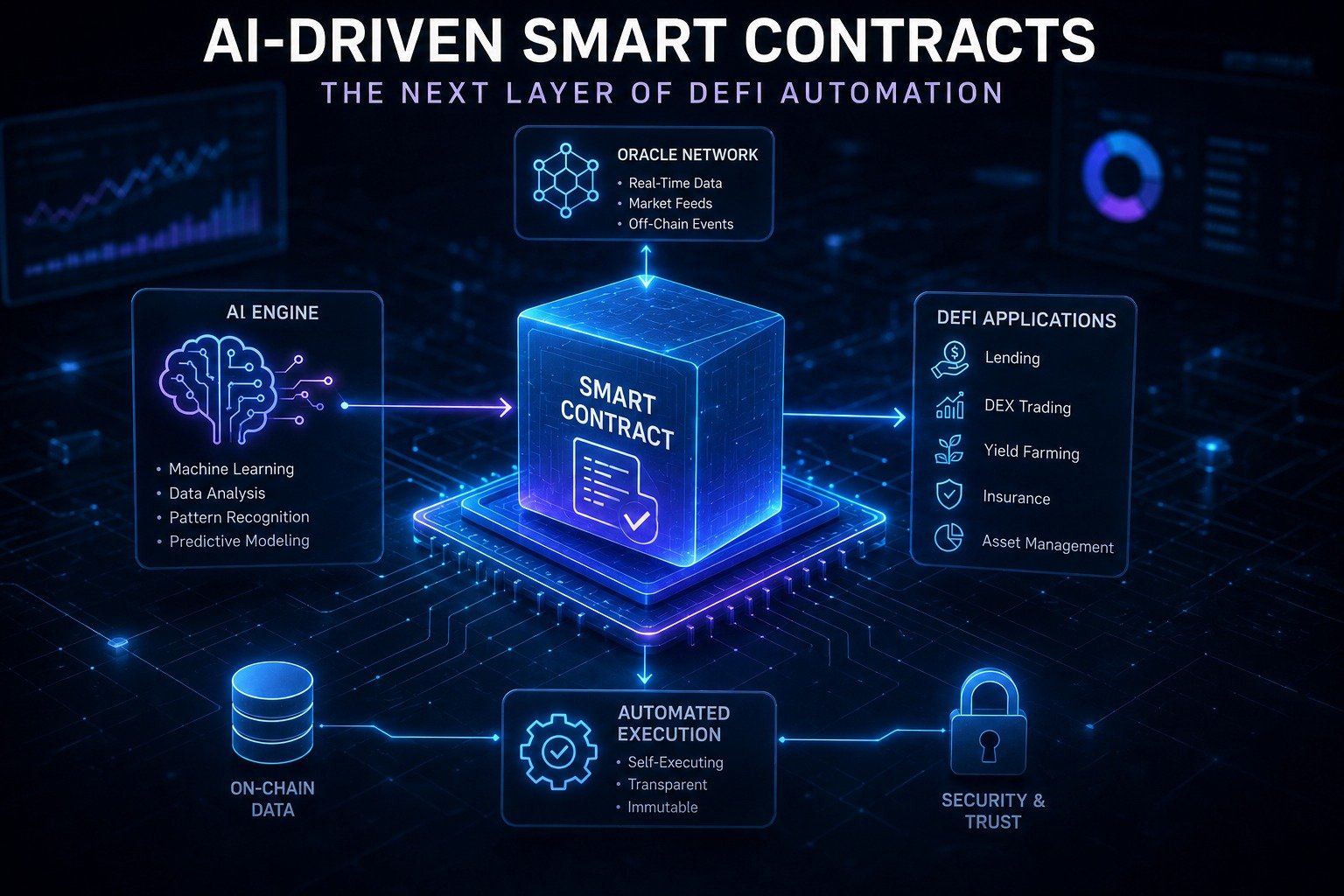
How AI-Driven Smart Contracts Work
A typical workflow involves several layers.
Step 1: Data Collection
AI systems gather information from sources such as:
- Market prices
- Trading volumes
- Economic indicators
- Blockchain activity
- User behavior
- Risk metrics
Step 2: AI Analysis
Machine learning models identify patterns, estimate probabilities, and produce recommendations.
Step 3: Oracle Delivery
Trusted oracle networks transmit AI outputs or relevant data to blockchain applications.
Step 4: Smart Contract Execution
The smart contract executes predefined actions based on those verified inputs.
Examples include:
- Rebalancing a portfolio
- Adjusting collateral ratios
- Updating interest rates
- Triggering automated trades
Step 5: Continuous Learning
Off-chain AI systems improve over time using new datasets, while on-chain execution remains deterministic and auditable.
Why AI Matters in DeFi
DeFi has grown into a multi-billion-dollar ecosystem.
However, challenges remain:
- Market volatility
- Complex investment strategies
- Liquidity fragmentation
- Security risks
- Inefficient capital allocation
AI helps address these issues by processing large datasets faster than humans and identifying patterns that can support better decisions.
Key Applications of AI-Driven Smart Contracts
Intelligent Yield Optimization
AI can monitor multiple yield opportunities across DeFi protocols.
Benefits include:
- Automatic fund allocation
- Higher efficiency
- Reduced manual intervention
Dynamic Lending
Traditional lending protocols often use fixed parameters.
AI can assist by evaluating:
- Borrower activity
- Market conditions
- Historical behavior
- Collateral quality
This can support more adaptive lending strategies within protocol-defined rules.
Automated Portfolio Management
AI-driven contracts can help maintain target asset allocations by initiating rebalancing according to preset criteria.
Fraud Detection
Machine learning models excel at identifying suspicious patterns.
AI may detect:
- Flash loan attack indicators
- Wallet anomalies
- Unusual transaction behavior
- Bot activity
Stablecoin Risk Management
AI can help monitor:
- Liquidity reserves
- Market volatility
- Peg stability
- Redemption pressure
Decentralized Insurance
AI models can evaluate claims and estimate risks, while smart contracts automate payouts based on protocol rules.
Benefits of AI-Driven Smart Contracts
Greater Automation
Fewer manual decisions are required for many routine DeFi operations.
Improved Efficiency
AI processes vast amounts of data quickly, helping optimize resource allocation.
Better Risk Assessment
Machine learning models can identify emerging risks that static rule sets may overlook.
Personalized Financial Services
AI can support tailored strategies based on user preferences, risk tolerance, and goals where protocols permit.
Continuous Optimization
AI systems improve as additional data becomes available, although blockchain execution remains bound by protocol logic.
Reduced Operational Costs
Automation can lower administrative overhead for decentralized financial platforms.
Real-World Use Cases
AI Trading Vaults
Investment vaults can use AI-generated signals to guide asset allocation while executing transactions through audited smart contracts.
DAO Treasury Management
AI may assist decentralized autonomous organizations (DAOs) by forecasting cash flow, optimizing treasury diversification, and analyzing governance proposals.
Cross-Chain Liquidity
AI can recommend liquidity allocation across multiple blockchain ecosystems to improve capital efficiency.
Supply Chain Finance
AI evaluates shipment and payment data while blockchain automates settlements and financing agreements.
Tokenized Asset Management
AI can assist with monitoring tokenized portfolios, suggesting rebalancing based on market conditions.
AI Technologies Behind Smart Contracts
Several AI disciplines contribute to intelligent blockchain systems.
Machine Learning
Identifies patterns and improves predictive models.
Deep Learning
Processes complex datasets using neural networks.
Natural Language Processing (NLP)
Analyzes governance proposals, legal documents, or financial reports.
Predictive Analytics
Forecasts market trends and protocol activity using historical data.
Reinforcement Learning
Optimizes strategies through repeated testing and feedback.
Challenges of AI-Driven Smart Contracts
Explainability
Complex AI models can be difficult to interpret, making transparency important.
Data Quality
AI outputs depend on accurate and reliable data sources.
Oracle Risk
Incorrect or manipulated external data can affect outcomes.
Computational Costs
Advanced AI models typically run off-chain because on-chain computation remains expensive.
Security
AI systems and smart contracts each require robust security practices.
Regulatory Uncertainty
Regulators are still developing frameworks for both AI and decentralized finance.
AI vs Traditional Smart Contracts
| Feature | Traditional Smart Contracts | AI-Driven Smart Contracts |
|---|---|---|
| Logic | Fixed | Adaptive inputs |
| Automation | Rule-based | Data-informed |
| Learning | None | Off-chain model improvement |
| Market Awareness | Limited | High (via external data) |
| Risk Analysis | Static | Dynamic |
| Efficiency | Moderate | Higher for suitable tasks |
| Complexity | Lower | Higher |
Investment Opportunities
Several sectors may benefit from the growth of AI-driven blockchain technologies.
AI Infrastructure
Distributed GPU networks and AI computing platforms.
Oracle Networks
Projects providing secure off-chain data to smart contracts.
AI Analytics Platforms
Protocols offering predictive insights for DeFi users.
Autonomous Trading
Platforms combining algorithmic trading with blockchain execution.
Security Protocols
Solutions focused on monitoring smart contract risks using AI.
Future Trends
Autonomous DeFi Protocols
Future protocols may increasingly automate treasury management, liquidity allocation, and governance support.
AI Agents
AI-powered agents could interact with multiple protocols on behalf of users while operating within predefined permissions.
Personalized Finance
Adaptive financial tools may offer increasingly customized experiences.
Cross-Chain Intelligence
AI may optimize asset movement across multiple blockchain ecosystems.
Institutional Adoption
Financial institutions are exploring blockchain automation supported by AI for operational efficiency.
Best Practices Before Investing
Before investing in AI-focused blockchain projects:
- Understand the project’s architecture.
- Review security audits.
- Examine token utility.
- Evaluate the team’s expertise.
- Verify AI claims with technical documentation.
- Diversify investments.
- Consider regulatory developments.
- Avoid projects promising unrealistic returns.
Frequently Asked Questions
Are AI-driven smart contracts fully autonomous?
Not entirely. In most implementations, AI operates off-chain to analyze data and generate recommendations, while blockchain-based smart contracts execute actions according to predefined rules.
Can AI replace smart contracts?
No. AI complements smart contracts by providing intelligence and analysis. Smart contracts remain responsible for secure, deterministic execution.
Is AI on the blockchain?
Most advanced AI computation occurs off-chain due to performance and cost constraints. Blockchain stores transactions and enforces execution rules.
Are AI-driven DeFi protocols safe?
Safety depends on smart contract quality, AI model reliability, oracle security, and governance mechanisms. Users should research protocols carefully.
What industries benefit beyond DeFi?
Supply chain management, insurance, healthcare, logistics, digital identity, asset management, and enterprise automation can all benefit from AI-enhanced blockchain systems.
Conclusion
AI-driven smart contracts represent a significant evolution in decentralized finance by combining blockchain’s trustless execution with artificial intelligence’s analytical capabilities. Instead of relying solely on fixed rules, next-generation protocols can leverage AI to support adaptive lending, portfolio optimization, fraud detection, treasury management, and other complex financial processes while maintaining transparent on-chain execution.
Although the technology is still developing, its potential extends well beyond DeFi into industries such as insurance, logistics, healthcare, and enterprise automation. Challenges—including data quality, explainability, oracle reliability, and regulation—must still be addressed, but ongoing innovation is rapidly improving the ecosystem.
For investors and developers alike, AI-driven smart contracts offer a glimpse into a future where decentralized applications become more intelligent, efficient, and responsive to real-world conditions. As AI and blockchain continue to converge, they are likely to form one of the foundational technologies powering the next generation of Web3.
No responses yet