Introduction
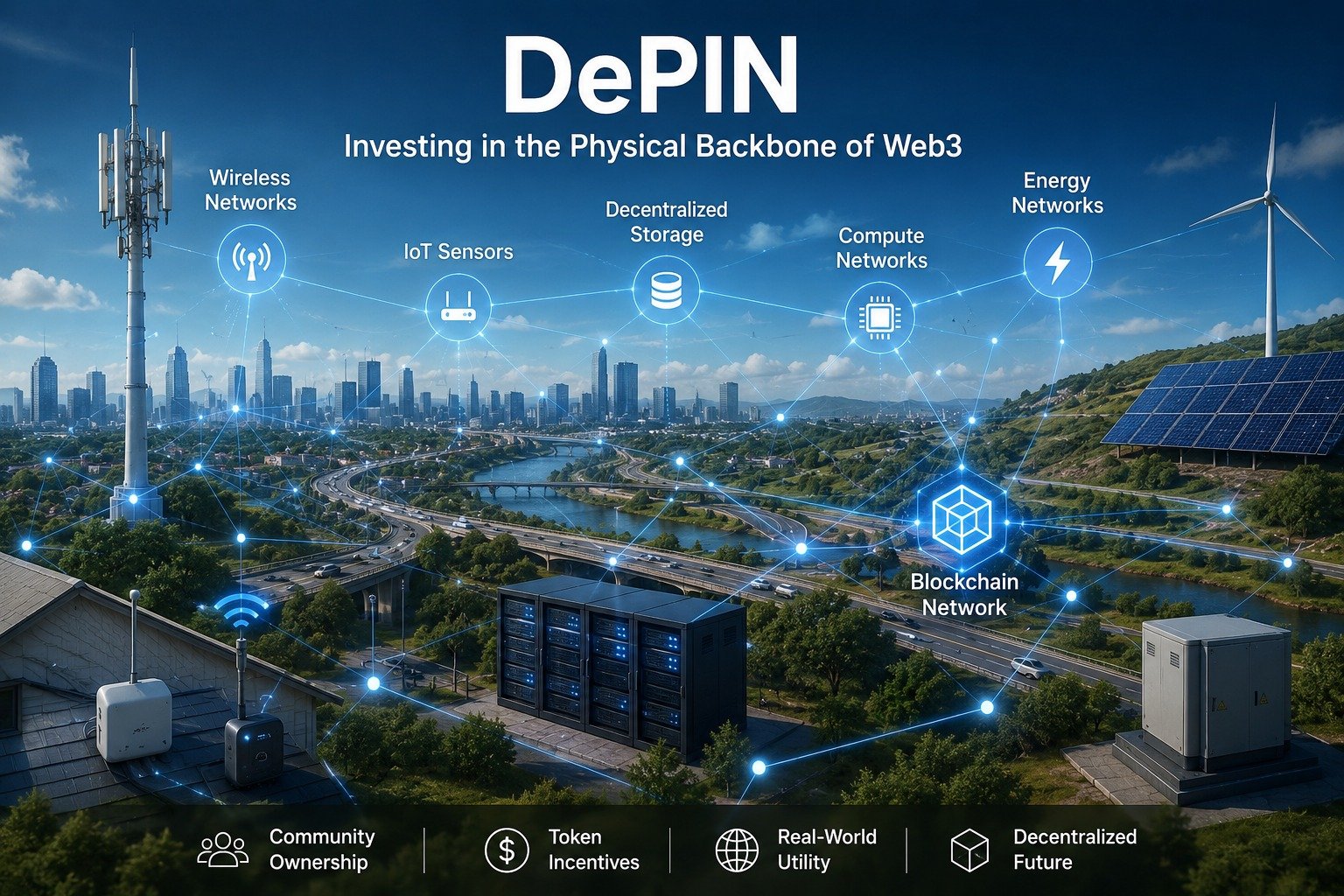
Blockchain technology has evolved far beyond digital currencies and decentralized finance (DeFi). As the Web3 ecosystem matures, a new category of blockchain innovation is emerging—Decentralized Physical Infrastructure Networks (DePIN). Unlike traditional blockchain applications that operate entirely in the digital realm, DePIN connects decentralized networks with real-world infrastructure such as wireless communication, cloud computing, energy systems, storage, transportation, and environmental sensors.
The concept is simple yet transformative: instead of relying on centralized corporations to build and maintain infrastructure, DePIN enables individuals and businesses to contribute physical resources and earn cryptocurrency rewards in return. This decentralized model has the potential to reduce costs, improve resilience, and accelerate innovation across multiple industries.
Over the past few years, DePIN has become one of the fastest-growing sectors in the blockchain industry. Investors increasingly view it as a bridge between Web3 and the real economy, making it one of the most exciting opportunities in crypto. As adoption grows, DePIN could reshape how infrastructure is owned, operated, and financed worldwide.
This comprehensive guide explores what DePIN is, how it works, its advantages, risks, investment opportunities, leading projects, and why it may become one of the defining narratives of the next generation of blockchain technology.
What is DePIN?
DePIN (Decentralized Physical Infrastructure Networks) refers to blockchain-powered systems that incentivize individuals or organizations to deploy and maintain physical infrastructure. Participants receive cryptocurrency rewards for contributing hardware or services to a decentralized network.
Unlike traditional infrastructure companies that require billions of dollars in capital investment, DePIN distributes infrastructure ownership across thousands of independent contributors.
Examples include:
- Wireless hotspots
- Data storage devices
- GPU computing hardware
- Electric vehicle charging stations
- Weather sensors
- Mapping cameras
- Internet connectivity equipment
- Renewable energy systems
These contributors collectively create decentralized infrastructure that users can access through blockchain-based marketplaces.
Why DePIN Matters
Modern infrastructure is largely controlled by centralized corporations. Cloud computing, telecommunications, mapping services, and energy distribution are often dominated by a handful of companies.
This creates several challenges:
- High operational costs
- Limited competition
- Single points of failure
- Geographic inequality
- Privacy concerns
- Slow expansion
DePIN introduces an alternative model where infrastructure grows organically through community participation.
Instead of one corporation building thousands of network nodes, thousands of independent participants contribute one node each.
The result is a more distributed, resilient, and scalable infrastructure network.
How DePIN Works
Although implementations vary, most DePIN ecosystems follow a similar process.
Step 1: Infrastructure Deployment
Participants purchase or operate compatible hardware such as:
- Wireless gateways
- Storage servers
- GPU computers
- Environmental sensors
- Cameras
- Energy devices
Step 2: Network Contribution
The hardware performs useful work by providing services such as:
- Internet connectivity
- File storage
- AI computation
- Location verification
- Mapping
- Energy sharing
Step 3: Blockchain Verification
The blockchain verifies that the service was genuinely provided through consensus mechanisms, cryptographic proofs, or usage metrics.
Step 4: Token Rewards
Contributors earn cryptocurrency tokens proportional to the value they provide to the network.
These rewards encourage continuous participation and network expansion.
Step 5: Consumer Usage
Businesses and consumers pay to access these decentralized services, creating sustainable demand for the network.
Core Components of DePIN
Every DePIN ecosystem generally consists of five elements:
Physical Hardware
Infrastructure deployed by participants.
Examples:
- Wi-Fi hotspots
- Storage nodes
- AI GPUs
- Sensors
Blockchain
Records transactions, rewards contributors, and maintains transparency.
Incentive Tokens
Native cryptocurrencies reward infrastructure providers.
Smart Contracts
Automate payments, governance, and service agreements.
End Users
Individuals and organizations consume infrastructure services by paying network fees.
Types of DePIN Networks
The DePIN sector spans numerous industries.
Wireless Networks
Decentralized wireless infrastructure allows individuals to provide internet connectivity using specialized hotspots.
Benefits include:
- Wider coverage
- Lower deployment costs
- Community ownership
Cloud Storage
Participants contribute unused hard drive capacity.
Users rent decentralized storage instead of relying solely on centralized cloud providers.
Advantages:
- Lower costs
- Better redundancy
- Increased privacy
Decentralized Computing
Participants contribute idle GPU or CPU resources.
Applications include:
- Artificial intelligence
- Scientific research
- Rendering
- Machine learning
Mapping Networks
Drivers collect mapping data using vehicle-mounted cameras.
Contributors earn tokens while improving decentralized mapping databases.
Energy Networks
Homes with solar panels or battery storage contribute electricity to decentralized energy markets.
Blockchain manages transactions between producers and consumers.
Environmental Monitoring
Individuals deploy sensors measuring:
- Air quality
- Temperature
- Weather
- Pollution
- Water quality
Governments and researchers can purchase this data.
Benefits of Investing in DePIN
Exposure to Real-World Assets
Unlike many speculative crypto assets, DePIN is tied to physical infrastructure that provides tangible utility.
Passive Income
Participants can earn recurring rewards by operating infrastructure devices.
Diversification
DePIN expands blockchain beyond finance into industries such as telecommunications, AI, transportation, and energy.
Growing Market Demand
Demand for decentralized infrastructure continues to increase due to:
- AI expansion
- Cloud computing growth
- IoT adoption
- Edge computing
- Smart cities
Strong Community Incentives
Token rewards encourage rapid network expansion without requiring centralized investment.
Lower Infrastructure Costs
Crowdsourced infrastructure often scales faster and more affordably than traditional corporate models.
Challenges Facing DePIN
Despite its promise, DePIN faces several obstacles.
Hardware Costs
Many networks require specialized devices with significant upfront costs.
Regulatory Issues
Governments may regulate telecommunications, energy, or data infrastructure differently across jurisdictions.
Token Volatility
Rewards fluctuate with cryptocurrency prices.
Adoption Risk
Some networks may struggle to attract enough users to sustain long-term demand.
Maintenance
Hardware failures, internet outages, or upgrades can reduce profitability.
Leading DePIN Use Cases
AI Infrastructure
Artificial intelligence requires enormous computing resources.
DePIN enables distributed GPU marketplaces where idle computing power is rented to AI developers.
Smart Cities
Cities can leverage decentralized sensor networks for:
- Traffic management
- Environmental monitoring
- Public safety
Telecommunications
Community-owned wireless networks expand internet access into underserved regions.
Supply Chains
IoT sensors verify shipment conditions and improve logistics transparency.
Renewable Energy
Blockchain-based energy trading allows households to sell surplus electricity directly to neighbors.
Tokenomics in DePIN
Most DePIN projects rely on carefully designed token economies.
Tokens typically serve several purposes:
Rewards
Infrastructure providers earn tokens.
Payments
Users pay for services using tokens.
Governance
Token holders vote on protocol upgrades.
Security
Some networks require staking to discourage malicious behavior.
Balanced tokenomics are essential for long-term sustainability.
Factors to Consider Before Investing
Investors should evaluate several factors before committing capital.
Utility
Does the network solve a genuine infrastructure problem?
Adoption
Growing user demand often drives sustainable token value.
Team
An experienced development team increases credibility.
Community
Active communities contribute to network growth.
Hardware Economics
Calculate:
- Device cost
- Expected rewards
- Electricity expenses
- Internet costs
- Payback period
Regulatory Environment
Infrastructure projects may face unique legal challenges.
DePIN vs Traditional Infrastructure
| Feature | Traditional Infrastructure | DePIN |
|---|---|---|
| Ownership | Corporations | Community |
| Expansion | Centralized | Distributed |
| Incentives | Corporate profits | Token rewards |
| Transparency | Limited | Blockchain-based |
| Entry Barrier | High | Lower |
| Governance | Central authority | Decentralized |
| Cost | Capital intensive | Shared investment |
DePIN vs DeFi
Although both belong to Web3, they serve different purposes.
| DeFi | DePIN |
|---|---|
| Financial services | Physical infrastructure |
| Lending | Connectivity |
| Trading | Storage |
| Yield farming | Computing |
| Digital assets | Real-world hardware |
DeFi focuses on finance, while DePIN focuses on infrastructure.
Risks of DePIN Investing
Investors should understand potential risks.
Market Volatility
Crypto prices remain highly volatile.
Technology Risk
Networks may fail to achieve technical milestones.
Competition
Multiple DePIN projects often compete in the same sector.
Hardware Obsolescence
Equipment may require upgrades.
Regulatory Changes
Governments may introduce new infrastructure regulations.
Future of DePIN
Several trends indicate significant growth potential.
Artificial Intelligence
AI demand for decentralized GPU resources continues to rise.
Edge Computing
Devices closer to users reduce latency.
DePIN naturally complements edge computing.
IoT Expansion
Billions of connected devices require decentralized infrastructure.
Renewable Energy
Decentralized energy trading is expected to grow rapidly.
Smart Cities
Urban infrastructure increasingly relies on decentralized data collection.
Best Practices for DePIN Investors
Consider these strategies:
- Research each project’s real-world utility.
- Understand hardware requirements.
- Diversify across multiple DePIN sectors.
- Monitor token economics.
- Review security audits.
- Evaluate long-term demand instead of short-term hype.
- Keep track of regulatory developments.
- Reinvest rewards wisely.
A disciplined approach can help manage risks while benefiting from the sector’s growth.
Frequently Asked Questions
Is DePIN only about cryptocurrency?
No. DePIN combines blockchain technology with physical infrastructure such as wireless networks, storage, computing, mapping, and energy.
Do I need hardware to invest?
Not necessarily. You can buy tokens associated with DePIN projects or participate by operating compatible hardware.
Why is DePIN important for Web3?
Web3 applications need decentralized infrastructure to avoid reliance on centralized service providers. DePIN provides that infrastructure through community participation.
Is DePIN suitable for beginners?
Yes, but beginners should thoroughly research projects, understand token economics, and avoid investing more than they can afford to lose.
Which industries benefit most from DePIN?
Telecommunications, cloud computing, artificial intelligence, renewable energy, logistics, environmental monitoring, and mapping are among the sectors benefiting most from DePIN.
Conclusion
Decentralized Physical Infrastructure Networks (DePIN) represent one of the most compelling evolutions of blockchain technology by extending decentralization beyond digital finance into the physical world. Through token-based incentives, DePIN enables individuals and businesses to contribute hardware, computing power, storage, connectivity, and other real-world resources to build community-owned infrastructure.
This model has the potential to reduce costs, improve resilience, accelerate deployment, and unlock new economic opportunities across industries ranging from telecommunications and AI to renewable energy and smart cities. For investors, DePIN offers exposure to a rapidly expanding sector that combines the innovation of Web3 with tangible real-world utility.
However, like any emerging technology, DePIN comes with challenges. Hardware costs, regulatory uncertainty, token volatility, and adoption risks require careful evaluation. Long-term success will depend on projects that solve genuine infrastructure problems, maintain sustainable token economies, and achieve widespread user adoption.
As Web3 continues to mature, DePIN is positioned to become a foundational layer of decentralized infrastructure. Investors who understand its mechanics, opportunities, and risks will be better prepared to navigate one of the most promising frontiers in blockchain technology.
No responses yet