Introduction
Ethereum’s transition to Proof of Stake (PoS) fundamentally transformed how investors participate in blockchain security and earn passive income. Before staking became mainstream, users often had to choose between locking up their ETH to secure the network or keeping their assets liquid for trading and decentralized finance (DeFi).
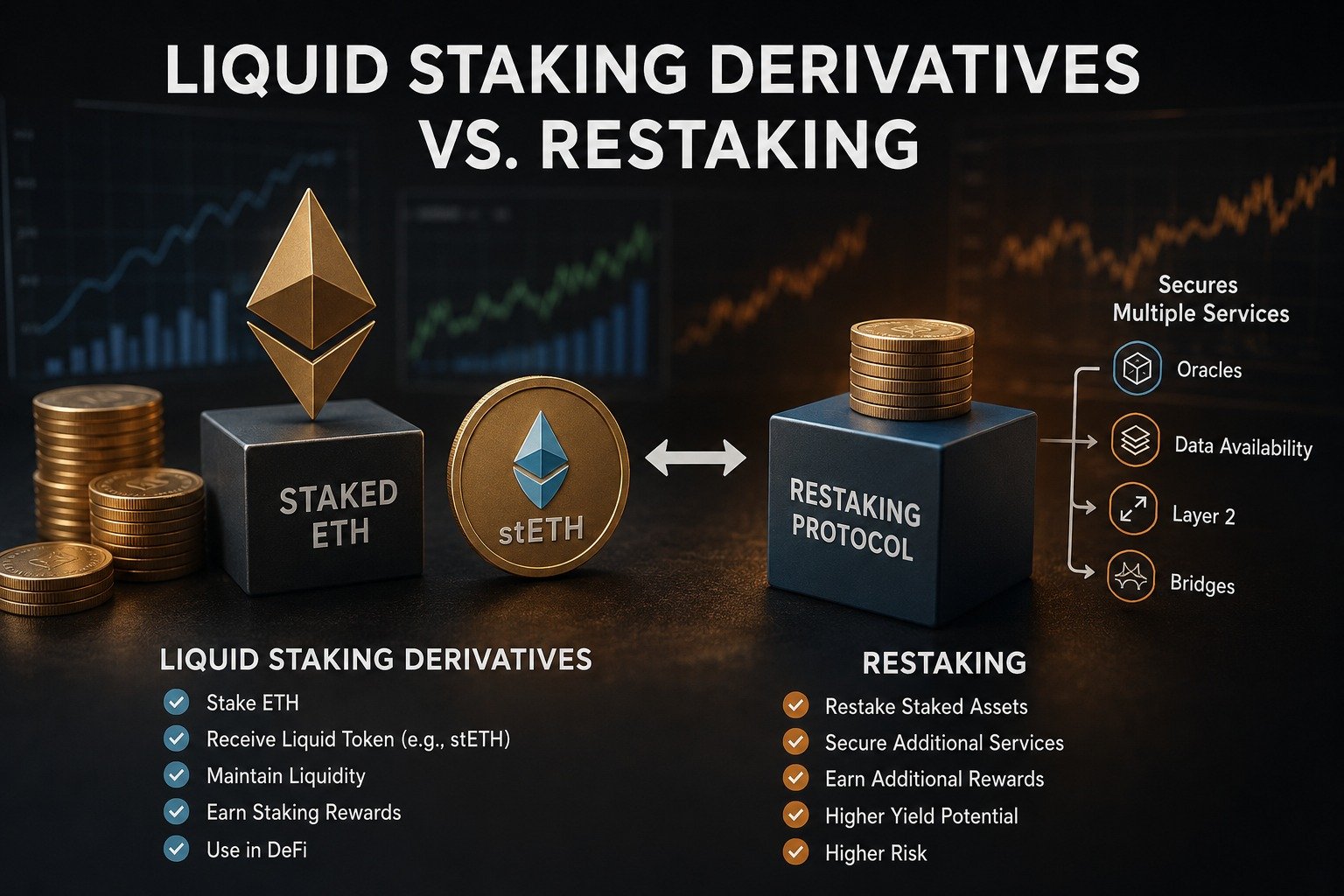
The introduction of Liquid Staking Derivatives (LSDs) changed that equation by allowing users to stake ETH while still receiving a tradable token representing their staked assets. More recently, Restaking has emerged as another innovation, enabling staked ETH to secure additional blockchain services while earning extra rewards.
Both technologies are reshaping decentralized finance, but they serve different purposes and carry different risks. Understanding these differences is essential for anyone investing in Ethereum or participating in DeFi.
This article explores Liquid Staking Derivatives and Restaking, comparing their mechanics, advantages, disadvantages, use cases, risks, and future potential.
What is Ethereum Staking?
Ethereum uses the Proof of Stake (PoS) consensus mechanism. Validators secure the network by locking ETH as collateral.
When users stake ETH, they help validate transactions and receive staking rewards.
Traditional staking has several limitations:
- Assets remain locked
- Reduced liquidity
- Opportunity cost
- Limited DeFi participation
These limitations inspired Liquid Staking.
What Are Liquid Staking Derivatives (LSDs)?
Liquid Staking Derivatives (LSDs) are blockchain tokens representing staked assets.
Instead of locking ETH without access, users receive a derivative token that can still be used throughout DeFi.
Example:
- Stake 10 ETH
- Receive approximately 10 stETH
- Continue earning staking rewards
- Trade or lend the derivative token
This innovation unlocked billions of dollars in previously inaccessible capital.
How Liquid Staking Works
The process typically follows these steps:
- Deposit ETH into a liquid staking protocol.
- The protocol delegates ETH to validators.
- Users receive derivative tokens.
- These derivative tokens appreciate or rebalance according to staking rewards.
- Users can redeem them later for ETH.
This process improves capital efficiency without sacrificing staking rewards.
Popular Liquid Staking Protocols
Several protocols dominate the liquid staking ecosystem.
Lido
The largest liquid staking protocol.
Features:
- stETH token
- Large validator network
- Extensive DeFi integrations
- High liquidity
Rocket Pool
A decentralized alternative emphasizing community-operated validators.
Advantages include:
- Permissionless node operators
- Strong decentralization
- Lower centralization risk
Frax Ether
Combines liquid staking with algorithmic monetary mechanisms.
Offers:
- sfrxETH
- High capital efficiency
- DeFi integrations
Binance staked ETH
Centralized exchange solution offering liquid staking for Binance users.
Advantages of Liquid Staking
Improved Liquidity
Users retain access to their assets while earning staking rewards.
Better Capital Efficiency
Derivative tokens can be:
- Lent
- Borrowed against
- Used as collateral
- Added to liquidity pools
Passive Income
Users receive staking rewards without actively managing validators.
Easy Participation
No need to operate validator infrastructure.
Broad DeFi Compatibility
Most major lending and yield protocols accept LSDs.
Risks of Liquid Staking
Despite the benefits, risks remain.
Smart Contract Risk
Bugs or vulnerabilities could result in losses.
Centralization
Large protocols control significant portions of staked ETH.
Peg Risk
Derivative tokens may temporarily trade below ETH.
Validator Risk
Poor validator performance may reduce rewards.
What is Restaking?
Restaking is an emerging innovation allowing already-staked ETH to secure additional decentralized services.
Instead of securing only Ethereum, staked ETH can secure:
- Oracle networks
- Data availability layers
- Layer-2 services
- Cross-chain bridges
- Middleware protocols
Users receive additional rewards for providing extra economic security.
How Restaking Works
A simplified workflow:
- Stake ETH.
- Receive an LSD token.
- Deposit the LSD into a restaking protocol.
- The protocol allocates security to additional services.
- Users earn multiple reward streams.
This creates layered yield opportunities.
The Rise of EigenLayer
One of the most influential restaking protocols is EigenLayer.
EigenLayer introduces the concept of shared security.
Rather than each decentralized application building its own validator network, applications borrow Ethereum’s security.
Benefits include:
- Lower infrastructure costs
- Faster ecosystem growth
- Shared validator security
- Additional validator income
EigenLayer has attracted billions in total value locked (TVL).
Types of Restaking
Native Restaking
Validators restake directly using validator credentials.
Liquid Restaking
Users restake Liquid Staking Derivatives.
Example:
ETH
↓
stETH
↓
Restaking platform
↓
Additional rewards
Operator Restaking
Professional validators provide additional services for new blockchain applications.
Benefits of Restaking
Higher Yield
Restaking provides:
- Ethereum staking rewards
- Additional protocol rewards
- Incentive tokens
Shared Security
New protocols gain Ethereum-grade security without building independent validator systems.
Better Capital Utilization
The same collateral secures multiple services.
Ecosystem Growth
Restaking lowers entry barriers for decentralized infrastructure.
Risks of Restaking
Higher rewards usually mean higher risk.
Slashing
Validators may lose funds if additional services are compromised.
Smart Contract Complexity
Restaking protocols introduce multiple contract layers.
Correlated Risk
Failures in one protocol may affect multiple ecosystems.
Regulatory Uncertainty
Restaking remains a relatively new financial primitive.
Future regulations could impact adoption.
Liquid Staking vs. Restaking
| Feature | Liquid Staking Derivatives | Restaking |
|---|---|---|
| Primary Goal | Liquidity | Additional Yield |
| Assets | Staked ETH | Staked ETH or LSDs |
| Rewards | Ethereum staking | Multiple reward streams |
| Complexity | Moderate | Higher |
| Risk | Lower | Higher |
| DeFi Usage | Excellent | Growing |
| Capital Efficiency | High | Very High |
| Smart Contract Exposure | Moderate | High |
Which Strategy Generates Better Returns?
There is no universal answer.
Liquid Staking
Best for:
- Conservative investors
- Beginners
- Long-term ETH holders
- Lower-risk yield seekers
Restaking
Better suited for:
- Experienced DeFi users
- Yield optimizers
- Higher risk tolerance
- Advanced portfolio strategies
Real-World Example
Suppose Alice owns 20 ETH.
Traditional Staking
- Stake 20 ETH
- Earn staking rewards
- Assets locked
Liquid Staking
- Stake 20 ETH
- Receive stETH
- Continue earning rewards
- Use stETH in lending protocols
Restaking
- Stake 20 ETH
- Receive stETH
- Deposit stETH into EigenLayer
- Earn Ethereum rewards plus restaking incentives
Potential returns increase—but so does risk.
Impact on the Ethereum Ecosystem
Liquid staking and restaking are transforming Ethereum.
Key improvements include:
- Increased liquidity
- Better capital efficiency
- Expanded DeFi innovation
- Lower infrastructure costs
- More secure decentralized applications
However, concerns remain regarding:
- Validator concentration
- Protocol dominance
- Systemic risk
- Governance centralization
Balancing innovation with decentralization will shape Ethereum’s future.
Future Trends
Several developments are likely over the coming years.
Institutional Adoption
Large financial institutions are increasingly exploring staking products.
Liquid Restaking Tokens (LRTs)
A new category combining liquid staking with restaking.
Examples include:
- ezETH
- rsETH
- eETH
Multi-Chain Expansion
Restaking concepts may expand beyond Ethereum.
Enhanced Security Models
New slashing protections and insurance mechanisms are expected.
Regulatory Clarity
Governments are gradually defining staking regulations.
Greater clarity may encourage institutional participation.
Best Practices for Investors
Before participating:
- Research protocol security
- Review audit reports
- Diversify across platforms
- Understand slashing conditions
- Monitor governance updates
- Avoid chasing unrealistic yields
- Keep a long-term perspective
Risk management remains essential.
Frequently Asked Questions
Is Liquid Staking safe?
It is generally considered safer than many DeFi strategies, but smart contract and validator risks still exist.
Is Restaking riskier?
Yes. Additional reward opportunities come with increased smart contract and slashing risks.
Can beginners use Liquid Staking?
Yes. Many platforms offer straightforward staking experiences.
Can Liquid Staking and Restaking be combined?
Yes. Many users first obtain an LSD token and then restake it to maximize capital efficiency.
Are rewards guaranteed?
No. Rewards depend on network conditions, validator performance, and protocol incentives.
Conclusion
Liquid Staking Derivatives and Restaking represent two of the most significant innovations in Ethereum’s Proof-of-Stake ecosystem. While Liquid Staking solves the liquidity challenges of traditional staking by issuing tradable derivative tokens, Restaking pushes capital efficiency even further by allowing the same staked assets to secure additional decentralized services and generate multiple streams of rewards.
For newcomers, Liquid Staking offers a simpler, lower-risk way to earn staking rewards while maintaining access to DeFi opportunities. More experienced users who understand smart contract, slashing, and protocol risks may find Restaking attractive for its higher yield potential and role in supporting emerging blockchain infrastructure.
Ultimately, neither approach is universally better. The right choice depends on your investment goals, risk tolerance, and technical understanding. As Ethereum continues to evolve, both Liquid Staking Derivatives and Restaking are expected to remain central pillars of decentralized finance, enabling greater liquidity, stronger network security, and more efficient use of digital assets.
Whether you prioritize stability or seek to maximize returns, staying informed about these technologies will help you make better decisions in the rapidly changing world of blockchain and DeFi.
No responses yet